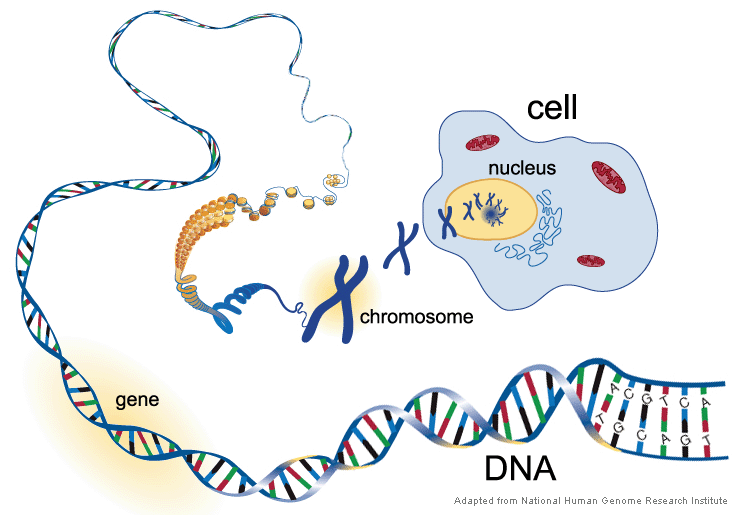
A chromosome is a structure of DNA, protein, and RNA found in cells. It is a single piece of coiled DNA containing many genes, regulatory elements and other nucleotide sequences.
A gene is the molecular unit of heredity of a living organism.
Asexual reproduction is a mode of reproduction by which offspring arise from a single organism, and inherit the genes of that parent only.
Sexual reproduction is a process that creates a new organism by combining the genetic material of two organisms.
There are two main processes in sexual reproduction.
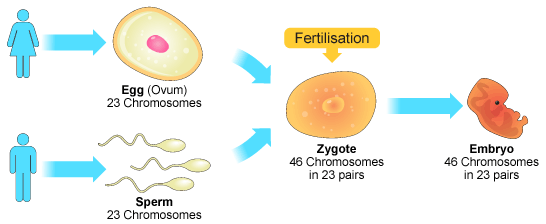
1. Meiosis – is a type of cell division necessary for sexual reproduction in animals, plants and fungi. The number of sets of chromosomes in the cell undergoing meiosis is reduced to half the original number, typically from two sets to one set.
The cells produced by meiosis are called gametes. In many organisms, including all animals and land plants gametes are called sperm in males and egg cells or ova in females.
2. Fertilization – involving the fusion of two gametes and the restoration of the original number of chromosomes.
The gamete (sperm or egg) carries one full set of chromosomes that includes a single copy of each chromosome.
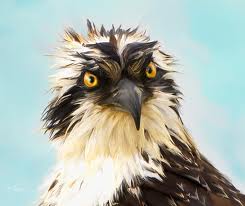
Osprey male gamete (sperm cell)
The female gamete (the egg or ovum) is the female haploid reproductive cell.
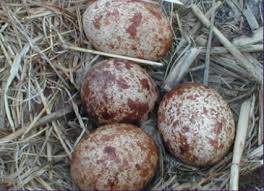
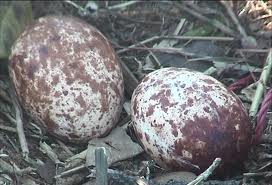
Osprey ovum (the egg)
The egg cell is not capable of active movement, and it is much larger than the motile sperm cells.
When egg and sperm fuse, a diploid cell (the zygote) is formed, which gradually grows into a new organism.
Osprey zygote
When does life begin? Does a zygote have a soul? Is live on earth precious? Is it worth saving? Is life on earth dispensable in the interest of higher forms? What if the inter-galactic DOT wishes to build a modern cosmic space though-o-fare that planet earth obstructs? Eminent domain?
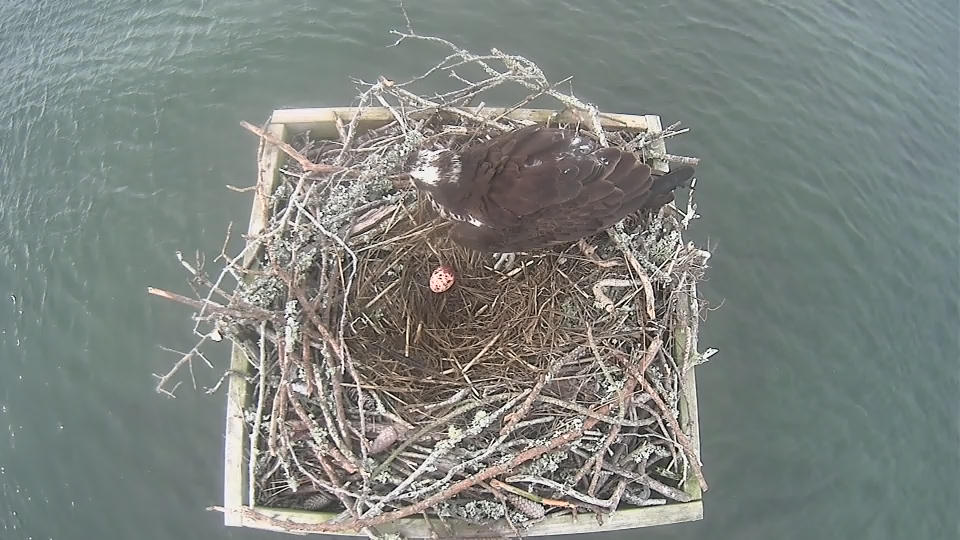
It’s not easy to see our two eggs. We keep them covered all the time. The Doctor was quick today though and got these two video clips.
.
.
. Today – (Easter Sunday)
Ozzy, What a guy!
Watch how he takes over the incubation and gives me a fish. He’s still a little bit awkward; it takes him 30 seconds or more to get situated, but he is right there for me all the time. I really love him.
.
.
.
.
Incubation begins when the first egg is laid. Subsequent eggs are laid one to three days apart, with 2-4 eggs in each clutch (never seven days apart!). The female usually takes on most of the responsibility of incubation, seldom leaving the nest except to feed. The male will take over incubation until she returns.
On average, the male will “spell” the female ten times per day.
Ozzy giving Harriett a break
Incubation lasts 34 to 40 days and if the eggs are fertile, they will hatch in the order they were laid.
Both osprey parents have a brood patch, although the female will incubate the majority of the time (around 70%).
Incubation can be a bit sporadic until the second egg arrives. I believe we observed this the first few days after Harriett laid her first egg. As one of our readers has commented, “maybe, just maybe, Harriett didn’t start incubating the first egg immediately as osprey eggs can remain viable for quite awhile before the incubation process begins”. This would also result in a shorter hatching interval, thus giving the second chick a better chance of survival.
During the evening, the female will normally do all the incubating.
Harriett got up on the wrong side of the nest this morning.
A bad feather day for Harriett
“I know what you are thinking, Doctor! So why don’t you just cut it out! Have a little deference for an egg laying female. Didn’t anyone teach you basic etiquette? Where are your manners?
“Wow, Harriett. Have you got a bug up your cloaca”? The Doctor responded.
“In my??? Why you unfledged primate”!!! Harriett ejaculated.
The Doctor did not realize how touchy Harriett was over having laid only one egg this week. In addition, being relatively new to telepathy, he did not realize his thoughts could be so easily read. Maybe he should change his password.
“I’m sorry, Harriett, said the Doctor. “But I’ve been telling my friends……”
“Oh! Shut down!” Harriett interrupted. “You are just making things worse…… Shut down and sign off”! Do it now!”
Indignation’s bad breath suffused the Doctors senses.
Indignation
What the Doctor did not know, at this time, was the degree of Harriett’s distress. The Doctor quietly and gently tuned in to Harriett’s aura.
“I thought I felt another egg coming today, but maybe it is just my imagination. Ozzie has been anxious all day. I do not mind saying that this first egg is real beauty. It is far and away the prettiest egg I have ever laid”. Perhaps my hopes are unrealistic, but I was thinking about 3 eggs this year. Ozzie is acting strange. He has not brought me a fish today. I hope he is not mad at me; why should he be? Surely he does not know about Havana.
“Having an argument with Harriett is a very unpleasant experience”, said the Doctor.
He fretted about it most of the afternoon. But, by evening all hurt feelings had resolved.
“It’s a lot easier to be angry at someone than it is to tell them you’re hurt”, he thought.
The Doctor was not angry. The Doctor never gets angry. He could sense Harriett checking him out from a distance and it made him feel needed.
“There is no better place to contemplate the creation of beauty than in your own back yard; a spider web, a blade of grass or a robin’s nest half way up your shade tree. In the springtime the beauty of life radiates so brilliantly that even humans stop and take notice”.
“From Photosynthesis to Oxidative Phosphorylation, living organisms are pumping out ATP like an interstellar nebula throwing off cosmic radiation”.
The Aesthetics of Osprey Eggs
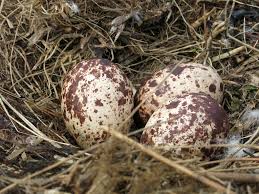
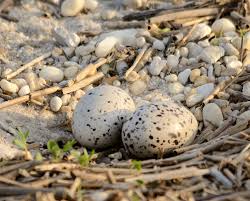
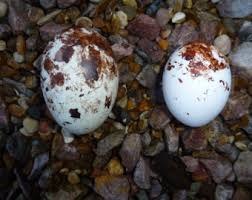
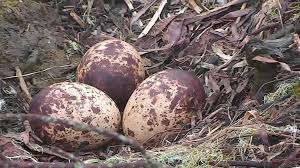
Osprey eggs are considered one of the most beautiful of all bird eggs. There is no contest among the other raptors. They have long been admired for their unusual coloring. Most osprey eggs have a brownish mottled coloring.
Others have rich browns,
and some have a white to cream-colored background covered with dots.
Here we see swirls as dark mahogany.
This particular clutch is very cinnamon.
Clutch-mates tend to have some artistic consistency, but there is enough variation that one wants to admire each entire clutch as an avian work of art.
Oology
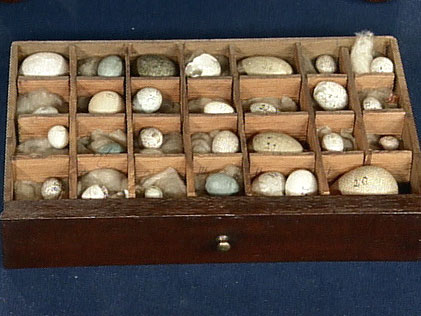
The stunning beauty of osprey clutches was not lost on the old naturalists. In the 19th Century the hobby of egg-collecting, was very popular.
Osprey egg-collecting played a major role in the population decline in the 19th and 20th centuries. There was even a little journal devoted to it, “The Oologist”.
Even now in some regions osprey populations remain low, even as the osprey population is starting to rebound.
There are still museum cases full of old Osprey eggs in Europe. Some are well preserved in these curio, throwback collections.
“Laying that first egg felt good and Ozzie is so proud. Ozzie has dramatically cut back on his cloacal kisses, which is natural and genetically programed.”
“Here are a few facts and figures you should know”.
On average, the period from first mating to egg laying.
1st Egg 16 days
2nd Egg 19 days
3rd Egg 22 days
Age at first breeding: 3-5 years
Number of eggs: Usually 3
Size of eggs (mm): 62 x 46
Incubation period: 35-42 days
Fledging period: 53 days
“Remember this date: April 9th”.
“It is an important date. This is the date from which we will anticipate the upcoming events.
“To understand osprey reproduction, one must know a bit about osprey anatomy”, said Harriett. “The Doctor will explain”.
The cloaca
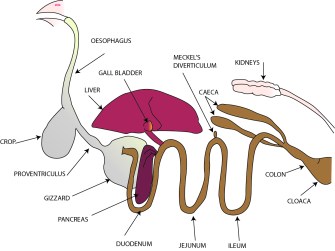
The cloaca is the posterior opening that serves as the only opening for the intestinal, reproductive, and urinary tracts of birds. The cloaca of males and females are the same. This confuses some humans. But, it’s not too hard to understand, if you take it step by step. First look at the digestive system of birds, then the urinary system and then the reproductive system. Then, just put them all together. It’s easy.
I do not think Harriett would mind showing us hers. Hang on a second. Let me ask.
OK, here it is:
Ozzie wants to show his too.
Copulation
Copulation is the method in which a male bird fertilizes the ovum of a female bird.
The male and female press their cloaca’s together for a few moments to transfer sperm to the female. Each copulation last about 15 seconds; it is fast and furious.
The arrival of the female is followed by a period of courtship that can last for up to three weeks. During courting the pair spends time together on the nest. The male brings the female all of her food.
When a pair of ospreys meet and start forming a bond the female wants the male to prove he will be able to provide for her and the chicks. She begs for food on his nest and he tries to meet her needs (courtship feeding).
Females in older pairs are fed more than females in younger pairs. It points to an inexperienced male.
Once they are settled at a site and start courtship feeding, mating can occur at almost any time.
An Osprey’s mating call consists of a brief “hew” and is repeated many times.
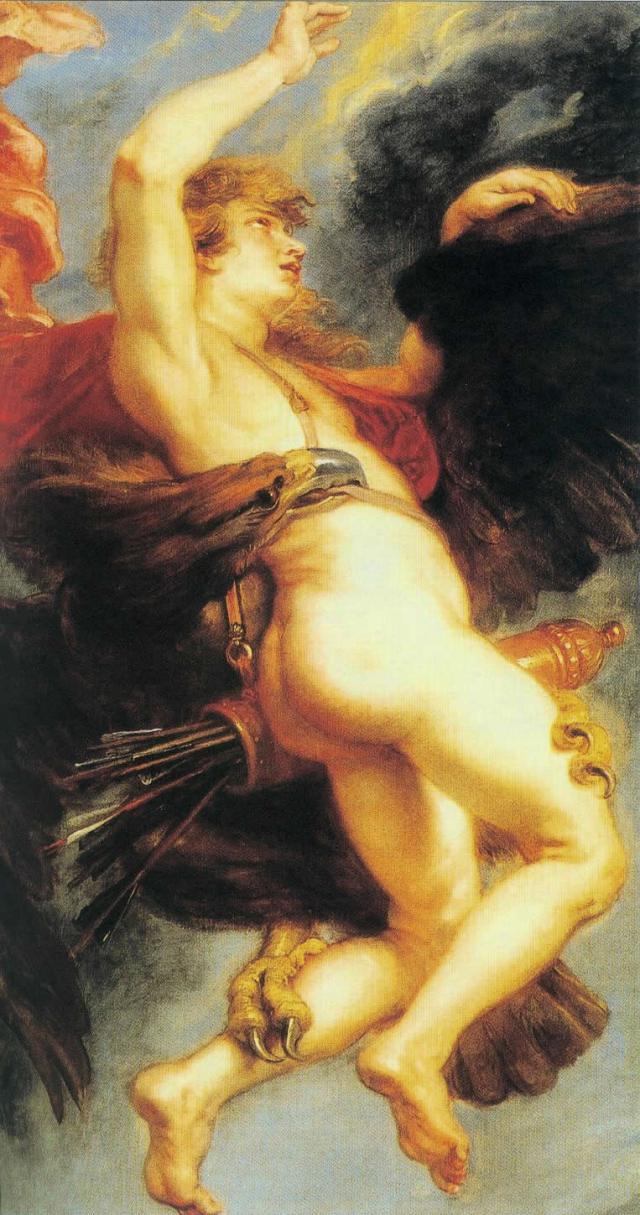
Most copulations take place at the nest because females spend most of their time there, but they can occur anywhere. No elaborate ritual or display precedes mating. Females sometimes appear to solicit copulations by tipping forward with raised tail and dropped wings, but this is subtle behavior and hard to decipher. At other times, it seems that the males mount with no signal from their mates, flying in from behind (like Yeat’s Zeus landing on Leda) or fluttering up onto the female from the nest edge.
Leda was daughter of the Aetolian king Thestius, and wife of king Tyndareus of Sparta. She was the mother of Helen of Troy. Leda was admired by Zeus, who seduced her.
Leda and the Swan by William Butler Yeats
~
A sudden blow: the great wings beating still
Above the staggering girl, her thighs caressed
By the dark webs, her nape caught in his bill,
He holds her helpless breast upon his breast.
~
How can those terrified vague fingers push
The feathered glory from her loosening thighs?
And how can body, laid in that white rush,
But feel the strange heart beating where it lies?
~
A shudder in the loins engenders there
The broken wall, the burning roof and tower
And Agamemnon dead.
Being so caught up,
So mastered by the brute blood of the air,
Did she put on his knowledge with his power
Before the indifferent beak could let her drop?
In general osprey copulations begin about 14 days before, and peak in the few days before the start of egg laying. They occur frequently, but only 39% of copulations result in cloacal kiss. It may take 160 copulation attempts to sucessfully fertilze a female to form a clutch of eggs.
Copulation occurs most often in the early morning. Female ospreys spent almost of their time (more than 95%) at the nest as they are fed there by the male. There is no association between courtship feeding and copulation, and hence no evidence that females trade copulations for food. Males maximized the time they spent at the nest with the female just prior to and during egg laying.
During copulation the female displays a posture of drooped wings and horizontal body, with her tail pointed up and to one side.
Note the female is receptive. She lifts her tail to offer her cloaca.
To mate, the male has to get on top of the female’s back. The female has to bring her tail up while the male brings his down.
Males mount females gently, talons closed and tarsi resting somewhat precariously along the female’s back; vigorous flapping helps the male maintain balance. If the female is receptive, she tips forward to allow the male’s tail to scissor under hers. Successful copulations, those in which the cloacae touch, depend on this forward tilt.
Unreceptive females refuse copulations by keeping a horizontal posture or by tipping back on their tails, so males just stand there flapping or slide off. Failed copulations are common. Young pairs are less likely to copulate successfully than old pairs, largely because young males are reluctant to transfer food, leaving their mates unreceptive to breeding.
This female is unreceptive.
They may continue mating until the hen lays the eggs. Pairs mate most frequently just prior to egg laying. Earlier copulations may have little to do with fertilization, serving instead to test a mate’s receptiveness (strengthen the pair bond) and to synchronize the development of the gonads. This latter aspect is especially important in young females (3 -4 year olds) because females arrive back at their nests with ovaries only partially developed, then going through a period of rapid ovarian development. In this phase, ovaries gain 5 to 15 times their initial weight before descending the oviduct.
The female calls the shots for successful mating; she needs to raise her tail and tilt forward so that the male can curl his tail under hers and achieve a cloacal kiss. This contact enables the sperm to pass from his cloaca into hers.
A male will land on a female’s back many times without this final contact being made. Studies have shown only 30-40% of attempts are successful. Early copulations stimulate the growth of eggs within the female’s ovary and strengthen the pair bond. The last 3 or 4 days before eggs are laid are the most critical for fertilization.
In a successful copulation the sperm travel to the female’s oviduct. This is where the various stages of egg development occur. First, the sperm fertilizes an egg which has been produced during ovulation and already has a yolk. Then the principal coating of albumin is applied before the outer and inner shell membranes are added. These stages take about 5 hours. Next the calcareous shell forms. The background pigments are laid down. The egg stays within the uterus for about 20 hours and tiny glands excrete the streaks and patterns that result in the darker markings on the shell. Finally the egg is laid. The eggs weigh between 60 and 80g and are about the size of duck eggs. The background color ranges from off white to pale brown, the mottling is red or dark brown. The first egg is usually the largest.
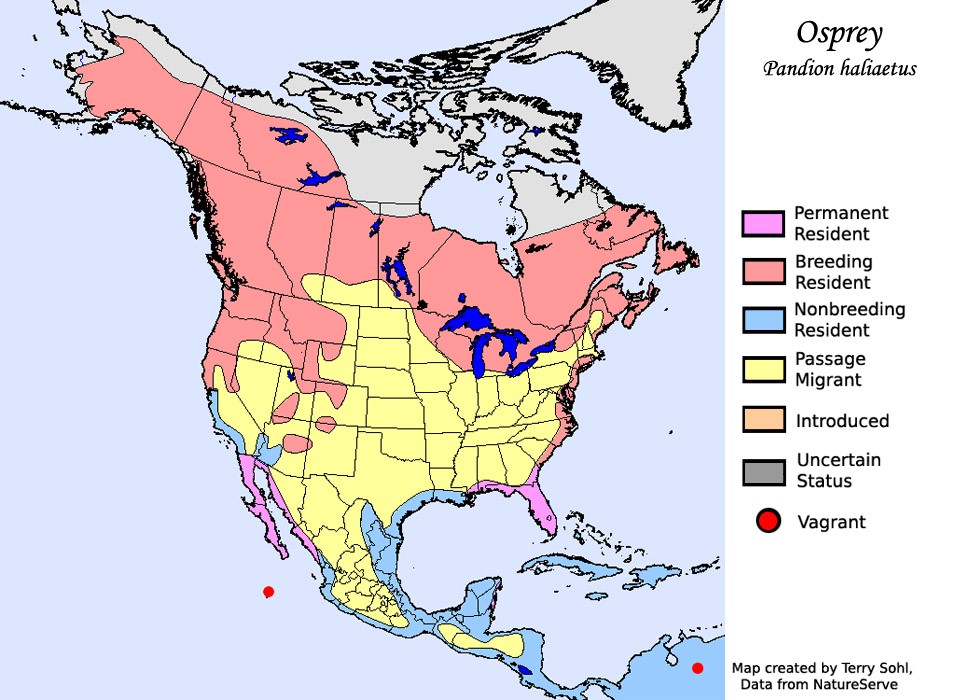
The osprey is one of our planets most widespread birds of prey. They can be found on every continent except Antarctica.
Ospreys in North America nest from northern Alaska; along the Atlantic coast as far south as the Florida Keys, and along the Pacific coast as far south as Mexico. The geography of their nesting sites affect the type of nest they build, and its placement.
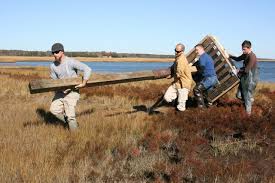
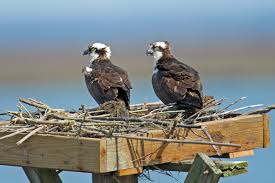
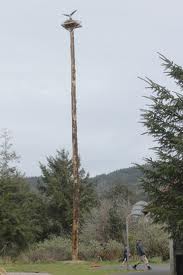
Generally, Ospreys reach sexual maturity and begin breeding around the age of three to four, though in some regions with high osprey densities, such as Chesapeake Bay, they may not start breeding until five to seven years old. Sometimes there is a shortage of tall structures, restricting the number of safe, suitable nest sites. If there are no nesting sites available, young ospreys may be forced to delay breeding.
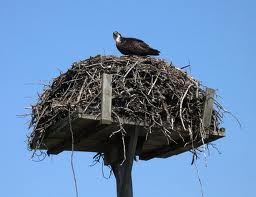
Human osprey enthusiast in these regions often erect platforms to provide more sites suitable for nest building.
First-year birds stay in South America during the spring. This is the notorious 18 months of a young osprey’s life. The adult birds return north. The immature osprey won’t leave the wintering grounds until their second year, and they won’t breed until they’re three or four.
Each year the older birds return to the exact site of last year’s nest. How they do it remains a cryptic wonder of nature. I doubt humans will ever figure it out.
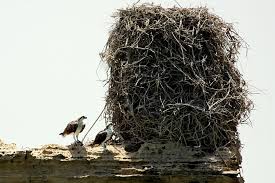
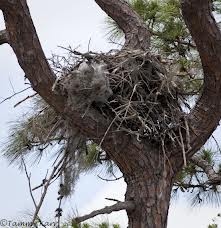
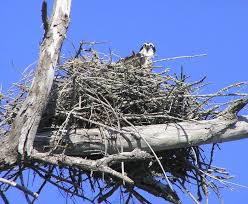
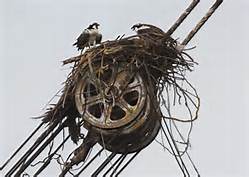
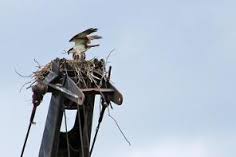
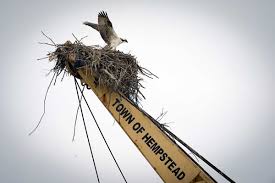
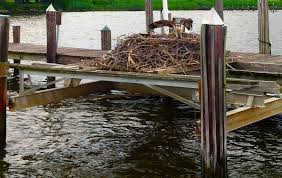
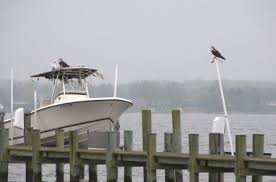
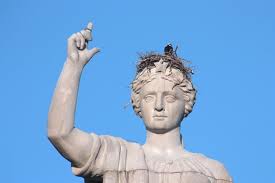
Ospreys want their nest sites out in the open for easy approach. They look for structures with a wide, sturdy base and safety from ground predators (such as raccoons). Nests are usually built in trees on snags, treetops, or crotches between large branches and trunks. Usually the male finds the site before the female arrives.
Every year their first priority is to re-build and bolster the nest. The female places and arranges most of the new sticks while the male acts as the gofer.
I hope you can open this file. Besides the nest building, you can see how easy it is to distinguish male from female. The male has an all-white chest and neck, whereas the female wears a necklace. Listen to their vocalizations; more on bird talk later.
The nest is constructed of sticks and branches, and is added to annually. An osprey’s nest may weigh as much as 400 pounds.
Nests usually are renovated and reused annually either until the base collapses or until the nest is damaged in a storm. Nests often are five feet across and two to three feet deep when they are first built and increase in size each year thereafter. Smaller birds, including House Sparrows and Monk Parakeets, sometimes nest within an Osprey’s nest. Osprey pairs can construct their nests in as few as seven to 10 days.
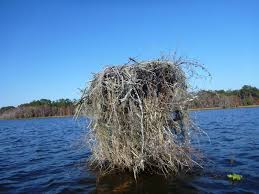
Ospreys deliberately chose highly visible nesting sites, or perhaps it’s more accurate to say that such a site makes the surroundings highly visible to the osprey. The nest sites are always near water with good visibility and limited access for predators.
The species’ preference for out-in-the-open nests may explain why nestling ospreys wear camouflaging coats of mottled down. Hopefully we will see some nestlings this summer. Aerial predators such as bald eagles, gulls, crows, and ravens have difficulty spotting the young from above.
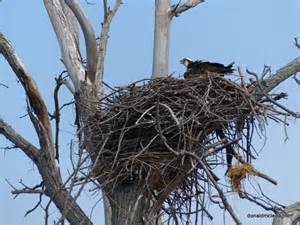
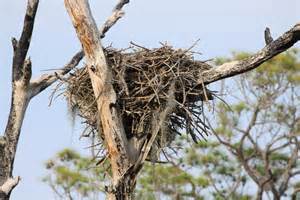
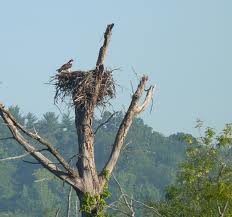
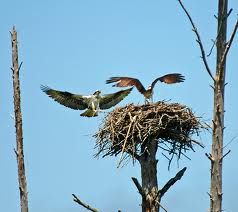
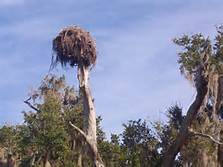
Ospreys have traditionally nested in the bare branches of dead trees. Typical nest sites are dead or relatively open live trees, in or within a few kilometers of open water.
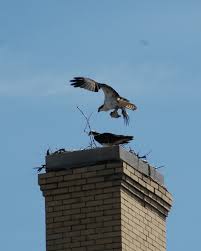
Regarding dead trees, ospreys have a penchant for tall trees devoid of their upper branches. They settle on top of the exposed trunk, giving them 360 degrees of visibility.
Examples:
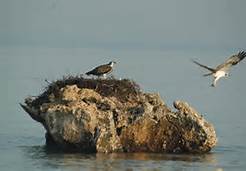
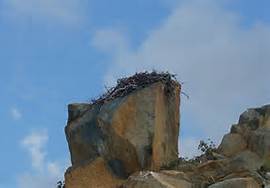
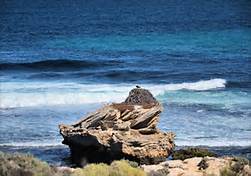
Rocky outcrops
Rocky outcrops just offshore are used if available. Many are renovated each season, and some have been used for 70 years. The nest is a large heap of sticks, driftwood and seaweed.
On the Ground
Sometimes ospreys nest on the ground. As long as it is save from predators, why not?
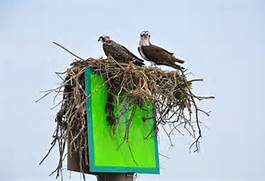
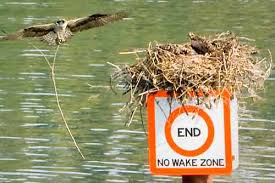
Channel markers
Channel markers are favorite osprey nesting sites.
Red for the sanguine Green for the phlegmatic
There is always the osprey that has to be different.
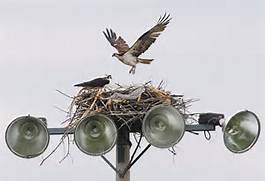
Light Towers
Some ospreys enjoy the spotlight.
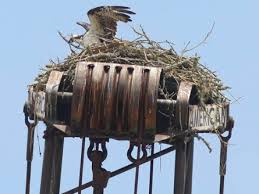
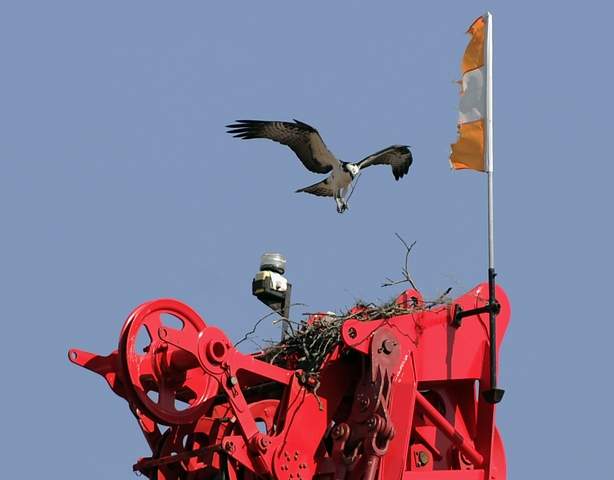
Construction equipment
This mischievous couple shut down a construction project in south Florida for six months last year. I can hear the cursing now.
It has happened before; more than once!
Ospreys are federally protected by the US Fish and Wildlife Service under The Migratory Bird Treaty of 1918. You cannot touch them!
The Headline News reports: “Osprey nest delays the removal of a construction crane” “Empire Construction Company goes bankrupt over Osprey controversy” “Construction suprentendent arrested for moving osprey nest”
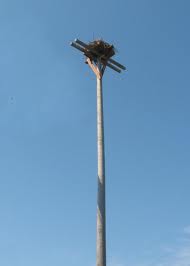
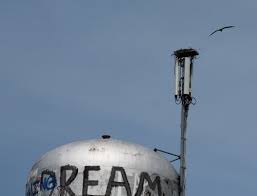
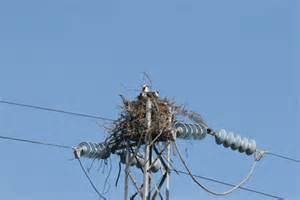
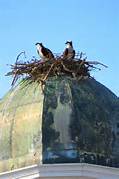
These sites are for high energy, emotionally charged ospreys with electric personalities, that do not mind high tension. They are thrill seekers who occasionally like to have a tingle or get a buzz on. Shocking news does not bother them.
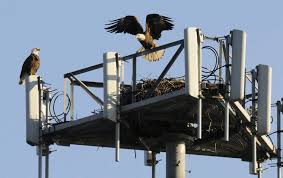
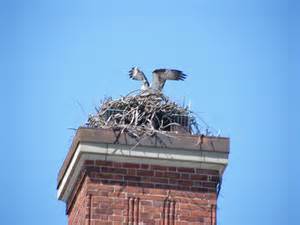
Cell phone towers, Microwave towers
Mostly chatty females, Geeks and Nerds
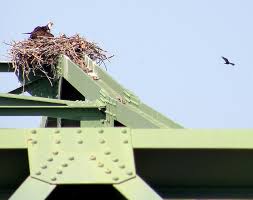
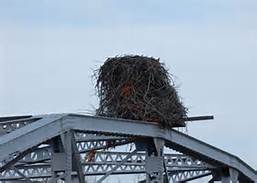
Highway Child
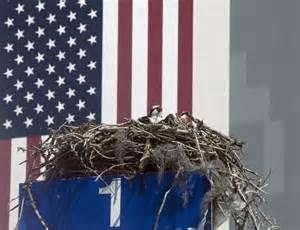
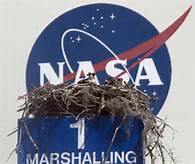
Patriotic American Osprey family Supporter of NASA
“It has come to the Doctor’s attention; there are children and grandchildren watching us. We osprey mature rapidly compared to the human species. I believe my understanding of human culture exceeds the Doctor’s understanding of ours, and I don’t mind telling you, I am offended by the Doctor’s comments regarding the Cultural Differences Argument.
Nonetheless, I offer this token of love to the children and grandchildren of the Doctor’s friends. The more we learn about each other, the better the world will be. This is someting the Doctor and I do agree upon”
But, before we go on;
The following section is considered G for general audiences.
In the case that you detect any PG, PG-13, R, or NC-17 content, please let the Doctor know.
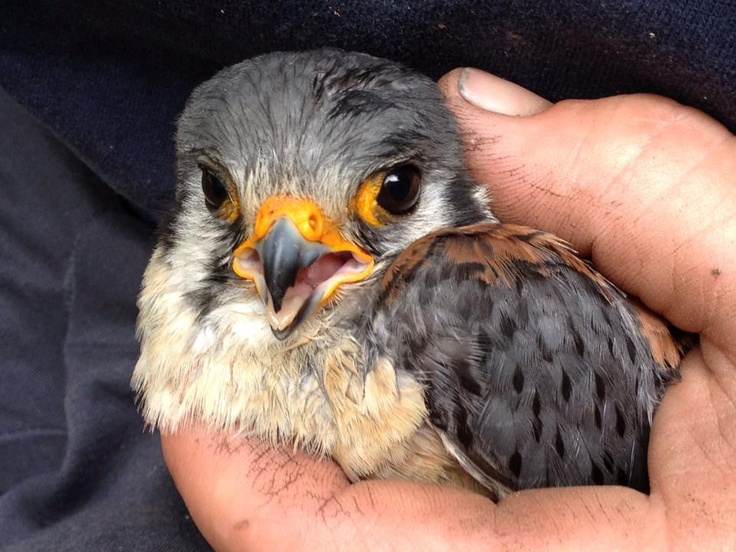
Do you want to see some baby ospreys? Well, they are right here:
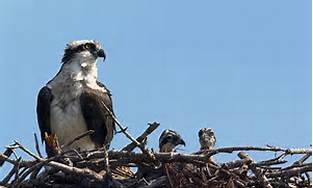
Here they are with their mother. She feeds and protects them until they are big and strong.
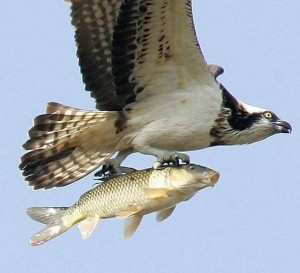
Their father catches fish for them and will teach them how to fly.
See the fish. It’s dinner time!
Come back and check out this web page any time you like. I guarantee it will be awesome, and you will learn some things that your parents and grandparents have not told you.




































 Osprey Tales