On behalf of my very best friend, I want to apologize to all of you for his poor judgment, heinous vulgarity, as well for his bad taste, foul mouth and inexcusable, ungentlemanly behavior. Never before have I heard such filth come from his beakless mouth. I’ll leave a bar of soap in his big nest tonight; he’ll know what to do with it.
In Summary:
1. I denounce the Doctor’s vulgarity in the strongest terms. OK, I’ll say it. “Foowy”!
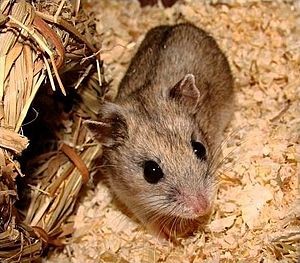
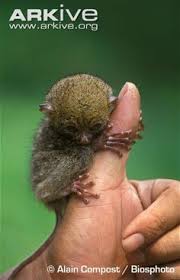
2. The second gremlin complicates the Doctor’s plan. The Plan must be changed, making the entire operation more complicated. We will probably need some Cricetulus griseus (rare Chinese hamsters).
“The Doctor has tired of the Gremlin. It will not interact with him and makes no effort to communicate; not even eye contact. Marley is afraid of the Gremlin and the Doctor’s bi-monthly nest cleaner will not clean the Doctor’s office any more. Even Angela seems to imperceptivity turn away from the Gremlin’s cage.
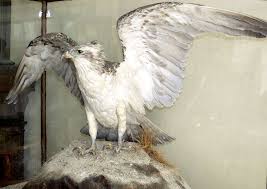
Taxidermy by Norman Bates
Here are a few facts I learned about the Gremlin by way of Marley’s mind.
The Gremlin’s real name is Mike. He has used Rocky, Mr. Imp and Adolf as aliases over the past 90 years. It is male, has never known a female Gremlin, and is afraid of hamsters. He likes to work alone and is especially talented in mechanical disruption. Until the digital age he thought his work in aircraft malfunction was his crowning achievement. He won several awards for his activities during World War II. But the advent of computers, the internet and digital data transfer has given him a new calling. Mike has embraced it with enthusiasm. What a windfall. Disrupting electronic data processing is so easy for Mike. He rejoioced, “Easy Street, now and forever”!
That was of course, until Marley and Cleo caught him.
Sorry to be so late. The Doctor forgot to leave the window open in his big nest, so I could not get to his computer this afternoon. Has anyone else noticed the Doctor being more forgetful lately? Oh well, forget about the Doctor’s forgetfulness for now.
Happily we are having a joyful telepathic jousting over dependability, reliability and responsibility. The Doctor debates well on these subjects.
A promise is a promise. Our ten day old baby osprey now has a name.
It is …………………………
Wait, before I tell you, I need to explain that it was Ozzie who made the final decision.
Confidentially, I favored “Storm” or “Stormy”. The Doctor liked “Skye” and “Zeus”. If anyone doubts that Zeus can be feminine, just take a look at the Doctor’s bridge teacher “Zeus”.
The Doctor’s Bridge Teacher
The human female that lives in the big nest with the Doctor wanted “Gale or Gayle”. Ozzie rejected them instantly.
“Sunny or Sonny” received more consideration but was forgotten immediately when Mrs. Mary Asbell’s kindergartner class submitted their suggestions.
As soon as Ozzie heard the name “Tweedy” he was fixated. No further discussion was possible. Ozzie put his Talons down and that was it.
I am glad too. I like the name “Tweedy”.
Congratulations to Mrs. Asbell’s Kindergarten class. They have named the bird.
Which animals, in all of the animal kingdom, have the best eyesight? You guessed it!
Birds of Prey (Raptors).
Falcon
Eagle
Hawk
Owl
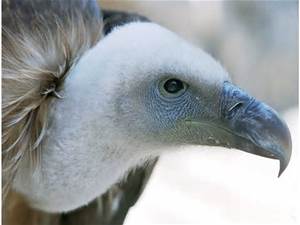
Vulture
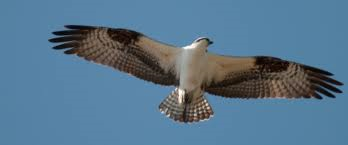
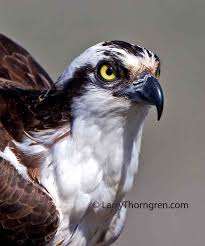
Osprey
. The Greatest Fisherman
And who is the best fisherman in all the animal kingdom? I know you know.
The Osprey!
The osprey is the greatest fisherman on planet earth
. Raptor Eyes
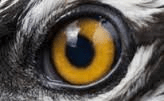
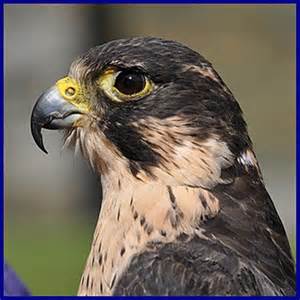
The visual accuity of raptors is legendary. The keenness of their eyesight is due to a variety of factors; raptors have large eyes for their size, and the eye is tube-shaped to produce a larger retinal image. The retina has a large number of receptors per square millimeter, which determines the degree of visual acuity. The more receptors an animal has, the higher its ability to distinguish individual objects at a distance, especially when, as in raptors, each receptor is attached to a single ganglion. Raptors have foveas with far more rods and cones than the human fovea. This provides them with spectacular long distance vision. In general raptors have distance vision 6 to 8 times better than humans.
. Forward Facing Eyes
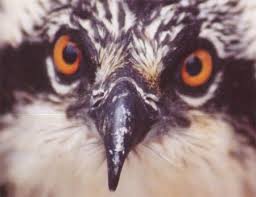
The forward-facing eyes of raptors provide binocular vision, which is assisted by a double fovea. The raptor’s adaptations for optimum visual resolution has a disadvantage in that its vision is poor in low light level.
Forward facing eyes
.
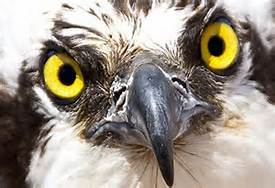
. The Osprey Stare
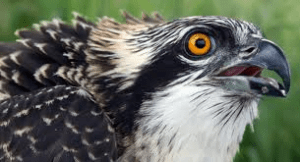
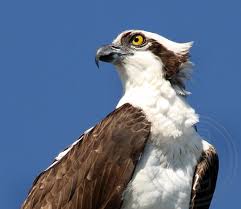
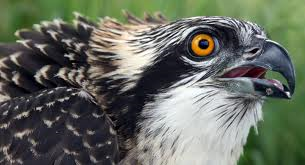
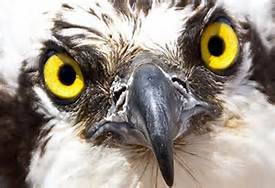
The arrangement of the feathers above the osprey’s eyes serves to reduce glare from the water surface when the bird is hunting for its staple diet of fish. It also gives the osprey its distinctive stare.
The Doctor has more, much more to tell you about our eyes and our incredible eyesight. It does not seem all that ammazing when you have it from birth, but I can “see” how those of you less fortunate could be envious.
Harriett returns to her nest. Carefully she straddles her eggs; arranges them, wriggles to get them below her brood patch, and contentedly huddles down.
The Doctor enjoys the soft, incoming, telepathic waves of happiness.
Broodiness In wild birds
Broodiness is the behavioral tendency to sit on a clutch of eggs to incubate them, often to the exclusion of other behaviors including feeding and drinking. Broodiness is usually associated with female birds, although males of some bird species become broody.
A wide range of incubation habits is displayed among birds. Body heat from the brooding parent usually provides the constant temperature required.
The most common pattern is the female does all the incubation, as in the Indian Robin.
Indian Robin
Or most of the brooding, as is typical of ospreys.
Osprey
In some species, such as the Whooping Crane, the male and the female take turns incubating the egg.
Whooping Crane
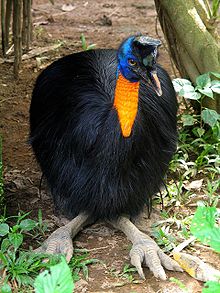
In others, such as the cassowaries, only the male incubates.
Cassowarie
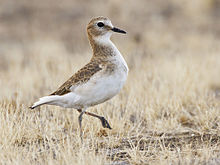
The male Mountain Plover incubates the female’s first clutch, but if she lays a second, she incubates it herself.
Mountain Plover
In all the species of wade-pipers the males become broody rather than the female. The females leave the nest after finishing laying to let the males incubate the eggs and take care of the young.
Red-neck wadepiper
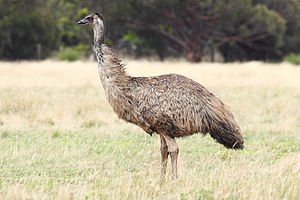
Emu males become broody after their mates start laying, and begin to incubate the eggs before the laying period is complete.
Emu
A small number of atypical birds such as Passeriformes of the genus Molothrus do not become broody but lay their eggs in the nests of other species for incubation, known as brood parasitism.
The Australian Brushturkey (Alectura lathami) also does not become broody, rather, it covers the eggs with a large mound of vegetable matter which decomposes keeping the eggs warm until hatching.
Australian Brush Turkey
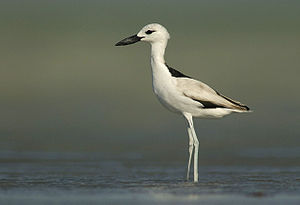
The Crab-Plover, (Dromas ardeola), which live on the coasts and islands of the Indian Ocean, let their eggs incubate primarily by the heat of the sun and will leave their nests unattended, occasionally for days at a time.
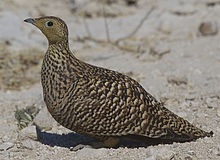
The Namaqua Sandgrouse of the deserts of southern Africa, needing to keep its eggs cool during the heat of the day, stands over them drooping its wings to shade them. The humidity is also critical, and if the air is too dry the egg will lose too much water to the atmosphere, which can make hatching difficult or impossible. As incubation proceeds, an egg will normally become lighter, and the air space within the egg will normally become larger, owing to evaporation from the egg.
Incubation refers to the process by which osprey hatch their eggs, and to the development of the embryo within the egg. The most vital factor of incubation is the constant temperature required for its development over a specific period.
Incubation time is defined as the period from the laying of the last egg until that egg hatches. The incubation time of osprey eggs is 34 to 40 days.
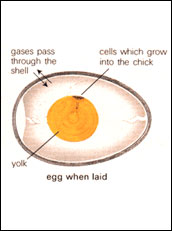
An egg is an organic vessel in which an embryo first begins to develop. The egg is the zygote, resulting from fertilization of the ovum, which is expelled from the body and permitted to develop outside the body until the developing embryo can survive on its own.
An embryo is a multicellular diploid eukaryote in its earliest stage of development, from the time of first cell division until hatching.
The act of sitting on eggs to incubate them is called brooding.
Harriett Brooding
Broodiness is the behavioral tendency to sit on a clutch of eggs to incubate them, often to the exclusion of other behaviors including feeding and drinking. Broodiness is usually associated with female birds, although males of some bird species become broody.
Heating the Egg
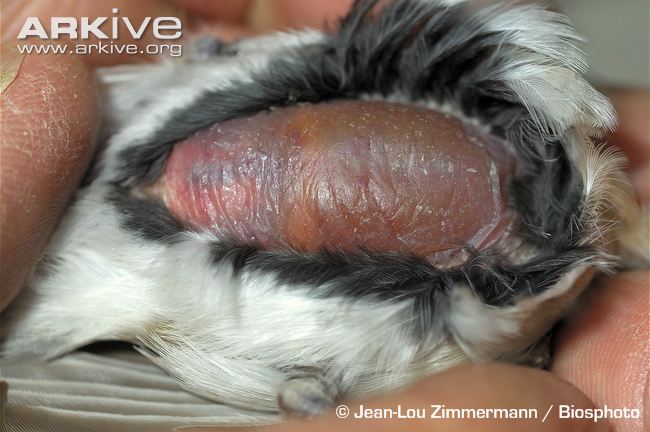
For an osprey egg to develop normally, it must be exposed for a considerable length of time to temperatures a few degrees below the normal 104 degrees, which is avian body temperature. The ideal incubation temperature for many birds’ eggs is human body temperature, 98.6 degrees. Most birds create the required temperature by sitting on the eggs and incubating them, transferring heat via a temporarily bare area of abdominal skin called the brood patch.
Brood patch on female pied flycatcher
Osprey egg temperature is regulated, in response to the environment, by varying the length of time she sits on them. Ospreys can sense the egg temperature with receptors in their brood patches. This helps them regulate their attentiveness (time spent incubating) more accurately. Since the embryo itself increasingly generates heat as it develops, periods of attentiveness generally decline as incubation progresses.
Eggs are turned periodically – osprey turn their eggs every 20 to 40 minutes. The turning helps to warm the eggs more evenly, and to prevent embryonic membranes from sticking to the shell.
A chromosome is a structure of DNA, protein, and RNA found in cells. It is a single piece of coiled DNA containing many genes, regulatory elements and other nucleotide sequences.
A gene is the molecular unit of heredity of a living organism.
Asexual reproduction is a mode of reproduction by which offspring arise from a single organism, and inherit the genes of that parent only.
Sexual reproduction is a process that creates a new organism by combining the genetic material of two organisms.
There are two main processes in sexual reproduction.
1. Meiosis – is a type of cell division necessary for sexual reproduction in animals, plants and fungi. The number of sets of chromosomes in the cell undergoing meiosis is reduced to half the original number, typically from two sets to one set.
The cells produced by meiosis are called gametes. In many organisms, including all animals and land plants gametes are called sperm in males and egg cells or ova in females.
2. Fertilization – involving the fusion of two gametes and the restoration of the original number of chromosomes.
The gamete (sperm or egg) carries one full set of chromosomes that includes a single copy of each chromosome.
Osprey male gamete (sperm cell)
The female gamete (the egg or ovum) is the female haploid reproductive cell.
Osprey ovum (the egg)
The egg cell is not capable of active movement, and it is much larger than the motile sperm cells.
When egg and sperm fuse, a diploid cell (the zygote) is formed, which gradually grows into a new organism.
Osprey zygote
When does life begin? Does a zygote have a soul? Is live on earth precious? Is it worth saving? Is life on earth dispensable in the interest of higher forms? What if the inter-galactic DOT wishes to build a modern cosmic space though-o-fare that planet earth obstructs? Eminent domain?
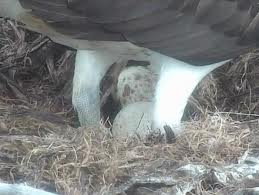
It’s not easy to see our two eggs. We keep them covered all the time. The Doctor was quick today though and got these two video clips.
.
.
. Today – (Easter Sunday)
Ozzy, What a guy!
Watch how he takes over the incubation and gives me a fish. He’s still a little bit awkward; it takes him 30 seconds or more to get situated, but he is right there for me all the time. I really love him.
.
.
.
.
Incubation begins when the first egg is laid. Subsequent eggs are laid one to three days apart, with 2-4 eggs in each clutch (never seven days apart!). The female usually takes on most of the responsibility of incubation, seldom leaving the nest except to feed. The male will take over incubation until she returns.
On average, the male will “spell” the female ten times per day.
Ozzy giving Harriett a break
Incubation lasts 34 to 40 days and if the eggs are fertile, they will hatch in the order they were laid.
Both osprey parents have a brood patch, although the female will incubate the majority of the time (around 70%).
Incubation can be a bit sporadic until the second egg arrives. I believe we observed this the first few days after Harriett laid her first egg. As one of our readers has commented, “maybe, just maybe, Harriett didn’t start incubating the first egg immediately as osprey eggs can remain viable for quite awhile before the incubation process begins”. This would also result in a shorter hatching interval, thus giving the second chick a better chance of survival.
During the evening, the female will normally do all the incubating.
Harriett got up on the wrong side of the nest this morning.
A bad feather day for Harriett
“I know what you are thinking, Doctor! So why don’t you just cut it out! Have a little deference for an egg laying female. Didn’t anyone teach you basic etiquette? Where are your manners?
“Wow, Harriett. Have you got a bug up your cloaca”? The Doctor responded.
“In my??? Why you unfledged primate”!!! Harriett ejaculated.
The Doctor did not realize how touchy Harriett was over having laid only one egg this week. In addition, being relatively new to telepathy, he did not realize his thoughts could be so easily read. Maybe he should change his password.
“I’m sorry, Harriett, said the Doctor. “But I’ve been telling my friends……”
“Oh! Shut down!” Harriett interrupted. “You are just making things worse…… Shut down and sign off”! Do it now!”
Indignation’s bad breath suffused the Doctors senses.
Indignation
What the Doctor did not know, at this time, was the degree of Harriett’s distress. The Doctor quietly and gently tuned in to Harriett’s aura.
“I thought I felt another egg coming today, but maybe it is just my imagination. Ozzie has been anxious all day. I do not mind saying that this first egg is real beauty. It is far and away the prettiest egg I have ever laid”. Perhaps my hopes are unrealistic, but I was thinking about 3 eggs this year. Ozzie is acting strange. He has not brought me a fish today. I hope he is not mad at me; why should he be? Surely he does not know about Havana.
“Having an argument with Harriett is a very unpleasant experience”, said the Doctor.
He fretted about it most of the afternoon. But, by evening all hurt feelings had resolved.
“It’s a lot easier to be angry at someone than it is to tell them you’re hurt”, he thought.
The Doctor was not angry. The Doctor never gets angry. He could sense Harriett checking him out from a distance and it made him feel needed.
“There is no better place to contemplate the creation of beauty than in your own back yard; a spider web, a blade of grass or a robin’s nest half way up your shade tree. In the springtime the beauty of life radiates so brilliantly that even humans stop and take notice”.
“From Photosynthesis to Oxidative Phosphorylation, living organisms are pumping out ATP like an interstellar nebula throwing off cosmic radiation”.
The Aesthetics of Osprey Eggs
Osprey eggs are considered one of the most beautiful of all bird eggs. There is no contest among the other raptors. They have long been admired for their unusual coloring. Most osprey eggs have a brownish mottled coloring.
Others have rich browns,
and some have a white to cream-colored background covered with dots.
Here we see swirls as dark mahogany.
This particular clutch is very cinnamon.
Clutch-mates tend to have some artistic consistency, but there is enough variation that one wants to admire each entire clutch as an avian work of art.
Oology
The stunning beauty of osprey clutches was not lost on the old naturalists. In the 19th Century the hobby of egg-collecting, was very popular.
Osprey egg-collecting played a major role in the population decline in the 19th and 20th centuries. There was even a little journal devoted to it, “The Oologist”.
Even now in some regions osprey populations remain low, even as the osprey population is starting to rebound.
There are still museum cases full of old Osprey eggs in Europe. Some are well preserved in these curio, throwback collections.