
Watch this first:
https://www.youtube.com/watch?v=gZaC8OXBMSc

Humidity is one of four primary variables which must be controlled during incubation – the others being temperature, ventilation and movement (or turning).
Egg shells are porous – they allow water to pass through.

All eggs have an air space. As water is lost through the shell it is replaced by air drawn through the shell.
This air space is the first air that the fully developed chick breathes and the space allows the developed chick some movement inside the shell to allow it to maneuver into hatching position.
The Eagle
Has been watching.
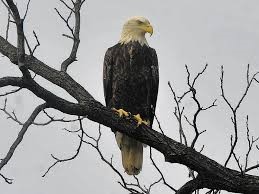
“There’s something going on here, but I don’t know what it is.”
Ospreys transfer their heat via a temporarily bare area of abdominal skin called the brood patch.
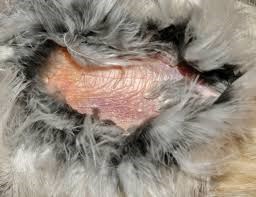
Large birds of prey such as ospreys and eagles have small brood patches which corresponds to a longer incubation time.
Ospreys can sense their embryo’s movements and temperature with receptors in their brood patches. This helps them regulate their attentiveness (time spent incubating) more accurately. Since the embryo itself increasingly generates heat as it develops, periods of attentiveness can decline as incubation progresses.
“When you see me rocking back and forth on my eggs, I am positioning them into my brood patch.”

The eagle’s brood patch
The act of sitting on eggs to incubate them is called brooding.

For an osprey egg to develop normally, it must be exposed for a considerable length of time to temperatures a few degrees below the normal avian body temperature of 104 degrees. The incubation time of osprey eggs is 35 to 39 days.
Successful incubation requires a brood patch.
A what?
Male provides female with all food during incubation. When the male brings in a fish, there is usually a” switch off”.
Female takes fish to nearby perch and feeds there; male incubates while female feeds, but sometimes will initiate incubation independent of food transfers.

Both sexes incubate. Females 80%, Males 20% – during daylight hours.
Females nearly always incubates at night.
“Switching off”
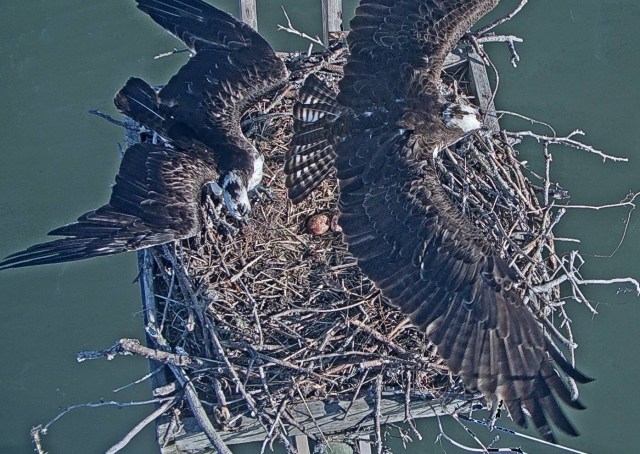
Incubation begins with the first egg, so the eggs hatch in sequence in 37-38 days.
(Due date May 17 – 18)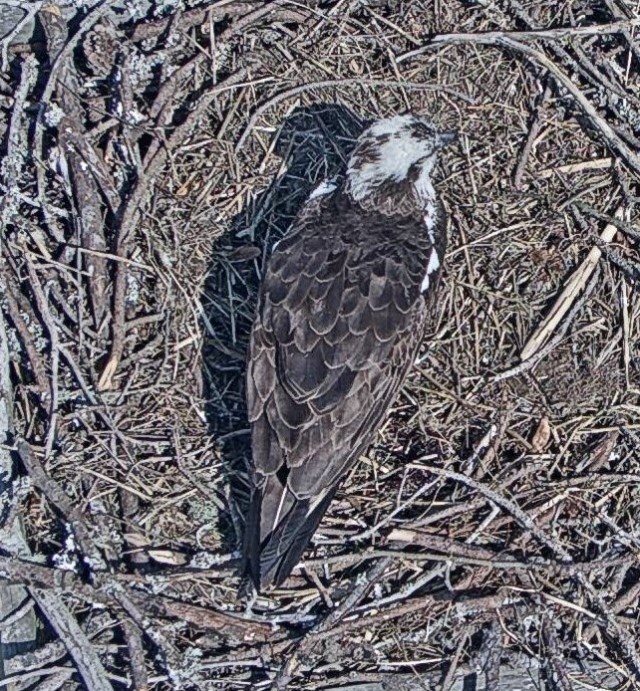
A three-egg clutch takes about 6-7 days to complete; a 4-egg clutch probably 8-10. Looks like a two-egg clutch this year. But that is wonderful.
Two is company
 | Joanne on The Life of Harriett: An Ospre… |
 | Louise Kelly on The Life of Harriett: An Ospre… |
 | Eliza Worthington on The Life of Harriett: An Ospre… |
 | Harriett Raptor on First flight |
 | Vicky on Hatchlings |

 Osprey Tales