Platform Construction – Part 1 -The Planning

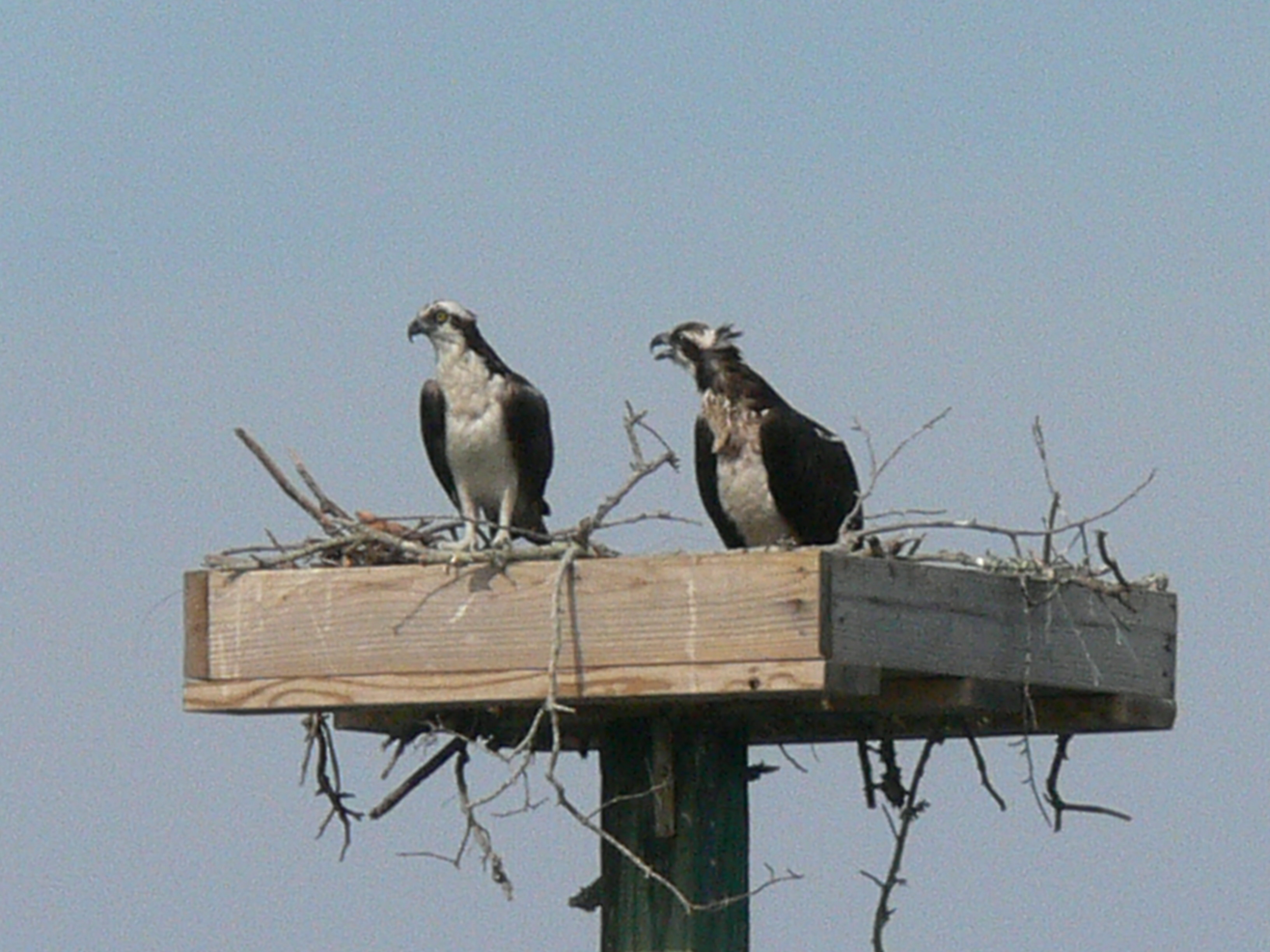
Ozzy and Harriett

I wanted to tell you about our 2012 winter in South America, but time is slipping away. It is only five or six weeks before we begin our migration home. It is hard to communicate telepathically during the flight. I’m not complaining but, well, you should try it sometime. I hope the Doctor has described to you, at least the basics, of migration. If not, I’ll have something to say to him when I get home.

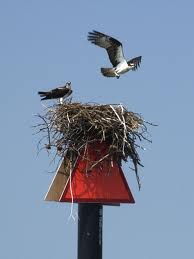
Poor Ozzie, I thought he was going to have a stroke last year, when the channel maker disappeared. Did Master Bridge player Emily Vaughn tell you what really happened to The Red Channel marker? If not, ask her. She will tell you about Occam’s razor* and the Fermi paradox.* If she will not tell, ask me. Sometimes it takes a bird to understand.

I wondered if Ozzie would use last year’s “living in a tree” nest site this year. You know Reggie Raccoon scared me terribly last summer and I really don’t want to be anywhere near that area. I doubted he would, as Ozzie is a smart bird and very thoughtful. I hoped he would be thinking about me when he got home to the North River. It is hard to suppress a smile at this point in the story. You will smile too, when you know what I hoped Ozzie would find.

I knew something that Ozzie did not. And what a surprise I hoped it would be for him!

The Doctor and I had been keeping in touch throughout the winter and I knew what he was up to. What a sweet guy. The story is a long, but it is a good one. Where to begin?

The Doctor builds us a Nesting Platform
December 2012 – January 2013

Other humans, including the one he lives with, consider the Doctor incompetent when it comes to any kind of carpentry and/or handyman work. I saw him trying to change a windshield wiper blade once. There was the time the garden hose froze and broke in half, then the dog dug a hole under the fence, and the garage door got stuck. Once he nailed a new brass scroll plant bracket to the back porch. It fell off mid-summer when his granddaughter, Molly, touched it. She began to cry, thinking she had broken it. Do you know the potato technique, if a light bulb breaks off it its socket? I don’t want to embarrass him, but candidly, the Doctor seems to lack his share of innate, practical, dexterousness, and has little aptitude for mechanically transforming thoughts into structure.

So, the human that lives with him was surprised when the Doctor announced he planned to build an osprey nesting platform for us.

Every day after work The Doctor retired to his home office and thought about what he might build. He was thinking of a structure with bold line, earthy tone and coarse texture. He wanted a geometric shape, but not too angular; large enough for the two of us, and hopefully chicks, but also intimate and cozy. The focal point would be 16.25 feet above the low watermark, so one’s eye could take in the constantly changing river background without disturbing the negative space within the structure.

Here are some preliminary sketches.

plan1         plan 3       plan2

One of his neighbors claimed he had to have a permit to build an osprey platform. This really annoyed the Doctor. He knew we needed a better site than that Old Black Locus Tree. Another neighbor said, “Well, you don’t need no stinking permit to build a duck blind!”, so our new home, under construction was called an “open air duck blind” for a long time.

permit1

The platform plans lay on his desk for two weeks. Each day after work he stared at them and shook his head. The practicality of the project began to worry him. He would have to buy a saw, and a drill, and some nails and screws, and maybe even some bolts or something. These are things that make him nervous and insecure.

“I really don’t know how to build things”, he mumbled to himself.

“What the hell is a 4 x 6”? “What does plumb mean”? What is meant by “treated” lumber? How tall should it be? What dimensions? Stainless steal, galvanized, iron, copper, zinc? What are they talking about? “Maybe I should not be doing this”, he questioned himself.

But The Doctor pressed forward. He studied the problem doggedly; looked at it from different perspectives and tried to think out of the box. He simplified his plans so they seemed more compatible with his practical skills of construction. Here are a few more of his sketches:

plan 4                   plan 5

Design and redesign consumed his thoughts for a month. By the end of January, the plans were complete. The final design came to him in a flash; it was an undeserved gift from The Muses. Deep in sleep perfection revealed itself as a work of art; a cultural symbol, unique in style, aesthetically pure and naturalistically real.
And here it is:
pla 6

Notice the way the elements of structure are composed within the image. See how the basic concepts and fundamentals of nature give it stability. Now look at the composition. See how it represents the variety of unity. That was the key; variety and unity, but how to combine these opposites? The answer is of course: create variety but keep the variety confined to being unified.

It was an epiphany and he knew it.
The Doctor was pleased. He reviewed the final plan one last time. It was perfect. Perfect in unnatural balance, proportion, harmony, rhythm, and non-movement.
“If I can create this structure”, the thought. “It will be the crowning achievement of my current life cycle”.

Posted in Ospreys | Tagged , , | Leave a comment

Living in a Tree – Introduction

Ozzie and Harriett reached sexual maturity in three years. Some ospreys take longer, but of course Ozzie did not.

The spring and summer of 2010 (Age 3 months – 18 months); was spent at Lake Maracaibo.

Their second breeding season, the spring and summer of 2011 (Age 20 months – 2 years); was spent on The Red Channel Marker, in the North River of Carteret County. Harriett wanted to go back to the Chesapeake Bay area, but it is the male who chooses the nesting site, and Ozzie choose Carteret County. The spring and summer of 2011 was The Summer of Fun.

The Summer of Fun was remarkable for:

– Migration home was easy that year.
– Ozzie and Harriett are head over heals in love with each other.
– They build a very nice nest for themselves on The Red Channel Marker.
– Harriett becomes an expert homemaker.
– Ozzie becomes an expert fisherman.
– Ozzie becomes poetic and recites a beautiful poem to Harriett.
– No eggs were laid, no chicks were born. It was not a nest failure, but a time of maturing love.

The Red Channel Marker

The spring and summer of 2012 (age 3 – 4 years); was different.

Ozzie’s return to the The Red Channel Marker was the most memorable and life altering experience of his life. Some birds, in retrospect, recall difficult, overwhelmingly painful times in their past, with nostalgia, and think of them as learning experiences. But what was about to come down in Ozzie’s life, can in no way be remembered as beneficial.

To be continued……………

Posted in Ospreys | Leave a comment

Eleven Facts You Should Know By Now

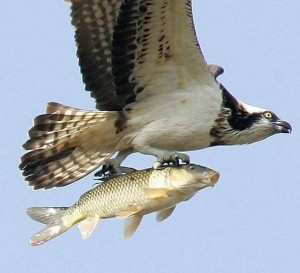
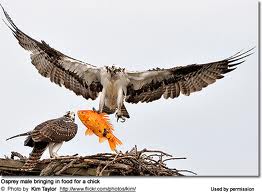
    1.  Ospreys are birds of prey, whose diet is almost exclusively fish.

            There is no better fisherman on planet earth than the osprey.


  1. The osprey is a raptor. Those of us from generation JurassicPark can’t help but think of the terrifying dinosaurs called Velociraptor.


  1. Osprey mate for life.


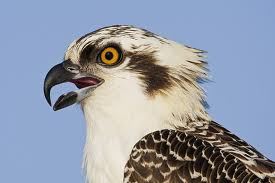
  1. The female is slightly larger that the male.  She wears a necklace.


  1. North American ospreys migrate to South America every fall to “winter” for the season.  The mates take “separate vacations”.  They use the magnetic fields of the earth to navigate.


  1. Ospreys have incredible eyesight. They can see eight times better than humans.  Ospreys are hunters, they must be able to see their prey, sometimes from great distances, and calculate just the right moment to strike. In fact, an osprey can spot a medium-sized flounder from at least one mile away.


  1. A skein is the symmetric V-shaped flight formation of migratory birds. The V formation greatly boosts the efficiency and range of flying birds, particularly over long migratory routes.


  1. Osprey pairs usually return to the same nest site year after year, and add new nest materials to the old nest each year.


  1. The Osprey tolerates a wide variety of habitats, nesting in any location near a body of water providing an adequate food supply. It is found on all continents except Antarctica, although in South America it occurs only as a non-breeding migrant.


  1. Human habitat is sometimes an aid to the osprey. The birds happily build large stick-and-sod nests on telephone poles, channel markers, and other such locations. Artificial nesting platforms are common in areas where preservationists are working to reestablish the birds.


  1. North American osprey populations became endangered in the 1950s due to chemical pollutants such as DDT, which thinned their eggshells and hampered reproduction. Ospreys have rebounded significantly in recent decades, though they remain scarce in some locales.


Posted in Ospreys | 1 Comment