The Doctor’s cameras are equipped with an ultraviolet light source.

We’re cold, Doctor !!!!! Tell Mom to come back.
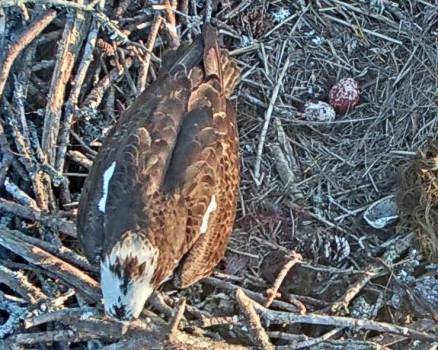
The Doctor’s cameras are equipped with an ultraviolet light source.

We’re cold, Doctor !!!!! Tell Mom to come back.
DDT thins the egg shells of many birds, especially the eggs of raptors. The thin shells can not stand the female’s incubation and cracke under pressure, during the time DDT was in widespread use.

Rachel Carson highlighted the dangers of DDT in her groundbreaking 1962 book Silent Spring. Carson used DDT to tell the broader story of the disastrous consequences of the overuse of insecticides, and raised enough concern from her testimony before Congress to trigger the establishment of the Environmental Protection Agency (EPA).

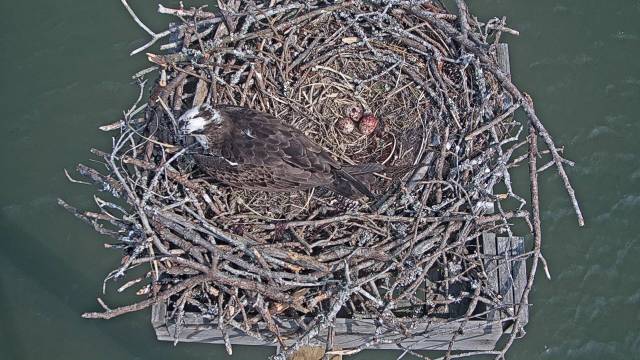
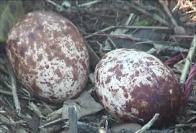
Two Eggs

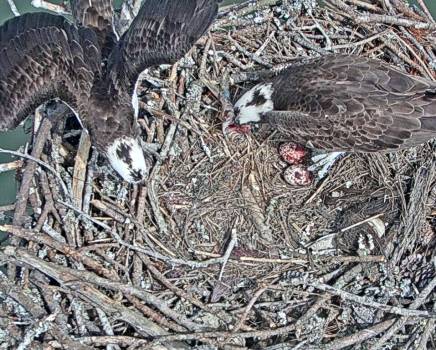
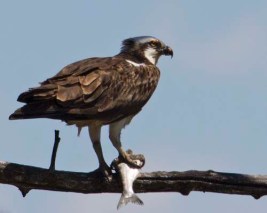
Parents

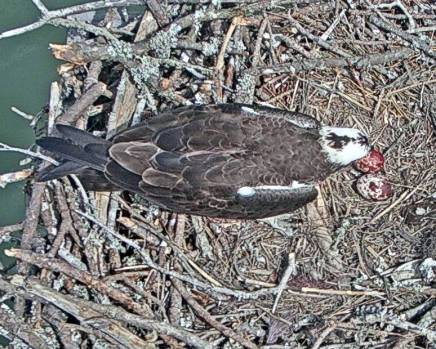
Proud Mom
The breeding season of migratory populations occurs in the spring and summer, with egg laying in April and May. Two to four eggs are laid over a period of several days, each 1 to 2 days apart. Both the male and female incubate the eggs, which hatch after approximately 40 days. Because incubation starts when the first egg is laid, the eggs hatch asynchronously in the order in which they were laid. Chicks that hatch first are larger and have a competitive advantage over those that are hatch later. If food becomes scarce, the smaller chicks are less successful in competing for food, and often die. This decrease in the number of chicks in the nest makes food more available to the surviving chicks, and increases their likelihood of survival. This process, common in raptors, is called brood reduction.
Ecological history

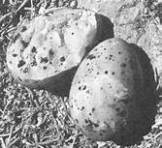
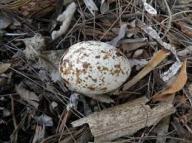
The stunning beauty of osprey clutches was not lost on the old naturalists. There was gamesmanship of climbing to nests to collect the eggs.
The 19th Century hobby of egg-collecting was called “oology”. There was even a little journal devoted to it, “The Oologist”, although this appears preposterous from our modern conservation perspective. The 20th Century result was museum cases full of dusty old blown-out eggs. These eggs have given us solid evidence of DDT’s affect.

Thanks for reading,
Harriett

I am very proud. Jonathan is ecstatic; he started flying huge circles around the nest screaming a high pitched creech-scree-creeeh!
Nesting Facts
The female lays two to four eggs within a month. The eggs are Cream to pinkish cinnamon with bold splotches of reddish-brown.
Clutch Size
1–4 eggs
Number of Broods
1 broods
Incubation Period
36–42 days
Nestling Period
50–55 days
Incubation begins when the first egg is laid. Subsequent eggs are laid one to three days apart; clutches have 2-4 eggs. The female usually takes on most of the responsibility of incubation, seldom leaving except to feed. The male then takes over incubation until her return.
Harriett Raptor
Coming up:
The DDT story

One of the most widespread birds of prey, the osprey is found on every continent in the world except Antarctica.
The osprey is also called the ‘fish hawk’, as it is well adapted for hunting fish.
The Osprey is the only hawk on the continent that eats almost exclusively live fish. In North America, more than 80 species of live fresh- and saltwater fish account for 99 percent of the Osprey’s diet.
Captured fish usually measure about 6–13 inches in length and weigh one-third to two-thirds of a pound. The largest catch on record weighed about 2.5 pounds. Ospreys get most of the water they need from the flesh of their prey, although there are reports of adults drinking on hot days.
Coming up next:
A reversible outer toe helps the osprey to carry fish while in flight.
The osprey plunges feet first to snatch them from the water, sometimes becoming completely submerged.

Adult male Ospreys usually arrive at their nesting sites a few days before the females. Together they build or rebuild their nest from last year. After a brief courtship (including The Sky Dance), the female settles into her nest and continues to make it comfortable. If all goes well, eggs are laid. There will be only one brood each year.
Age at first breeding: 3-5 years
On average, the period from first mating to egg laying is:
1st Egg 16 days
2nd Egg 19 days
3rd Egg 22 days
Number of eggs: Usually 3
“I know what you’re thinking Doctor. You certainly have been non-communicative this year. What’s the matter? Has your telepathy failed you? I can feel your brain working. If you won’t say it, I will.”
“The doctor is calculating when I may lay my first egg. However he is nervous, anxious, apprehensive. Last year’s surprise of Ozzie’s demise and a nest of no eggs really shook him. But, that’s what I’ve been trying to tell him all along.”
This is nature. This is the real thing. You never know what to expect. That’s why our relationship is so important.”
Harriett
Adept at soaring and diving but not as maneuverable as other hawks, Ospreys keep to open areas, flying with stiff wing beats in a steady, rowing motion.
Primarily solitary birds, they usually roost alone.
Nesting Ospreys defend only the immediate area around their nest rather than a larger territory; they vigorously chase other Ospreys that encroach on their nesting areas.
In breeding season, males perform an aerial “sky-dance,” sometimes called “fish-flight.”
With dangling legs, often clasping a fish or nesting material in his talons, the male alternates periods of hovering with slow, shallow swoops as high as 600 feet or more above the nest site. Sustaining this display for 10 minutes or more, he utters repeated screaming calls while gradually descending in an undulating fashion to the nest.

Goodness gracious! I’ve never seen such an industrious bird. I thought Ozzie was the cream of the crop, but Jonathan is impressing me more and more, day after day. He is tireless. In addition to bringing me nest material, he’s defending our Taj Mahal from intruders and if you been watching closely he has been doing a little sky dancing too.


To quote The Doctor, “I think she’s starting to like this guy.”
Wow! Jonathan has really proved himself this week. Look at all the sticks he has brought for our nest.
http://northriverosprey.axiscam.net:8000
I am busy arranging them so that we might have a warm and snuggly nest this year.
Not only that, we had two intruders attack, trying to take over the Taj Mahal. You should’ve seen Jonathan protecting me. Those two interlopers ended up continuing to fly North. It only took Jonathan a few hours the morning of Saturday 3/25/2017 to make it clear to them that The Taj Mahal is ours!
The Doctor tried in vain to snap a photograph of the four of us fighting. I understand this would be a difficult photograph. I thanked him anyway for trying to share this event with you all.
Channel markers are favorite osprey nesting sites.

Any place, high, safe, with a wide field of vision and plenty of fish will do: